Abstract
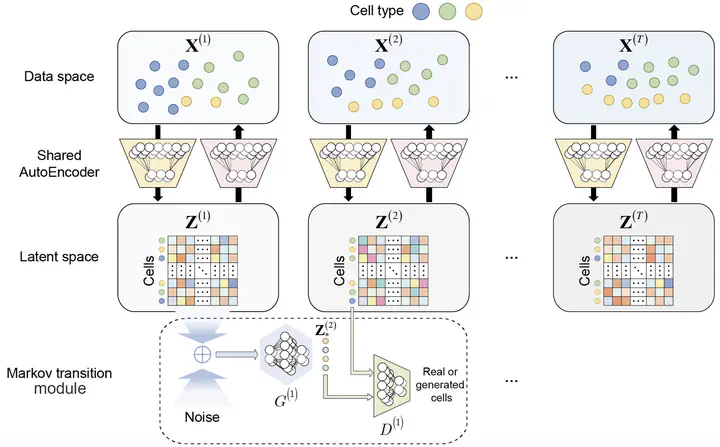
Single-cell time-series data offer a unique opportunity to study how cell states emerge, evolve, and diversify over time. However, cells are destructively measured across time points and individual cells cannot be directly tracked, making it challenging to reconstruct cell-state transitions and uncover the dynamic regulatory programs. Existing methods are predominantly based on optimal transport and typically require predefined low-dimensional representations, which can limit scalability, flexibility, and mechanistic interpretability. Here we present scMTG, a single-cell Markov transition generative framework that jointly learns cell representations and temporal cell-state transitions from unpaired single-cell time-series data. In a series of experiments, scMTG demonstrates superior performance in interpolating held-out missing-time-point data and inferring cross-time-point transition matrices, compared with state-of-the-art methods. More importantly, the learned Markov transition generator provides an interpretable framework for identifying the molecular programs that drive cell-state changes, enabling characterization of cell fate decisions and construction of time-resolved regulatory networks. Together, scMTG provides a unified generative framework for reconstructing cellular dynamics and uncovering regulatory programs that shape development, differentiation, and disease progression.
Add the full text or supplementary notes for the publication here using Markdown formatting.
Xuejian Cui
PhD student (joint w. Rui Jiang, 2024–2026)
My research interests include computational biology, and single-cell intelligent analysis.
Haochen Wang
Postdoctoral Associate
Haochen earned his Bachelor of Electronic Engineering degree at Xidian University, where he focused on signal processing and computational techniques. He then pursued his Ph.D. in Control Science and Engineering at Tsinghua University under the guidance of Dr. Xiaowo Wang. His doctoral research concentrated on developing deep generative models for designing genetic elements, with a focus on synthetic biology applications. He also has previous research experience in DNA sequence generation with artificial intelligence during his time at the Shenzhen Institute of Advanced Technology, and computational analysis of single-cell perturbation data at Cartabio Technology. Haochen joined Yale University as a Postdoctoral Associate, and he is currently working on generative models on computational biology.
Zijing Gao
PhD student (joint w. Prof. Rui Jiang)
My research interests include generative AI, Bayesian statistics, and computational biology.
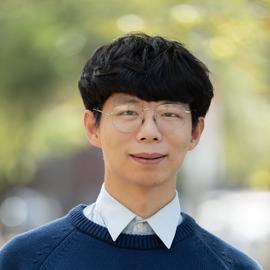
Qiao Liu
Assistant Professor of Biostatistics
My research interests include generative AI, high-dimensional data analysis, and computational biology.