RegFM: an interpretable context-aware foundation model for human transcriptional regulation
Abstract
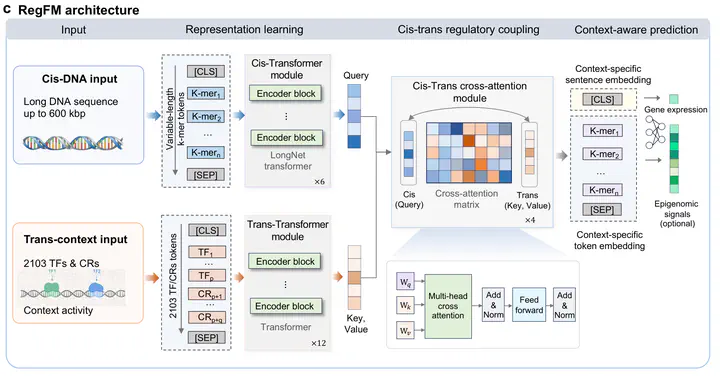
Transcriptional regulation is governed by interactions between cis-regulatory elements (CREs) and trans-acting regulators in a context-specific manner. Although DNA and single-cell foundation models have enabled modeling regulatory biology at scale, most represent either sequence or cellular state alone, limiting their ability to capture context-dependent gene regulation. Here we present RegFM, a context-aware foundation model for human transcriptional regulation. RegFM treats transcriptional regulation as a dialogue between cis-regulatory sequences (e.g., CREs) and trans-acting regulators (e.g., transcription factors (TFs) and chromatin regulators (CRs)) by coupling long-range CRE representations with TFs and CRs activity. Trained on large-scale ENCODE and CELLxGENE transcriptomic profiles, RegFM learns gene-centered regulatory representations that generalize across unseen cellular contexts. In a wide range of tasks, including gene expression prediction, cis-regulatory element annotation, bivalent promoter and dosage-sensitivity classification, and perturbation-response prediction, RegFM consistently improves over existing methods. RegFM emerges as a scalable and interpretable framework for modeling human transcriptional regulation and provides insights into context-dependent gene regulatory programs.
Zijing Gao
PhD student (joint w. Prof. Rui Jiang)
My research interests include generative AI, Bayesian statistics, and computational biology.
Haochen Wang
Postdoctoral Associate
Haochen earned his Bachelor of Electronic Engineering degree at Xidian University, where he focused on signal processing and computational techniques. He then pursued his Ph.D. in Control Science and Engineering at Tsinghua University under the guidance of Dr. Xiaowo Wang. His doctoral research concentrated on developing deep generative models for designing genetic elements, with a focus on synthetic biology applications. He also has previous research experience in DNA sequence generation with artificial intelligence during his time at the Shenzhen Institute of Advanced Technology, and computational analysis of single-cell perturbation data at Cartabio Technology. Haochen joined Yale University as a Postdoctoral Associate, and he is currently working on generative models on computational biology.
Qiao Liu
Assistant Professor of Biostatistics
My research interests include generative AI, high-dimensional data analysis, and computational biology.