BGM-IV: AI-Powered Bayesian Generative Modeling for Instrumental Variable Regression with High-Dimensional Covariates
Abstract
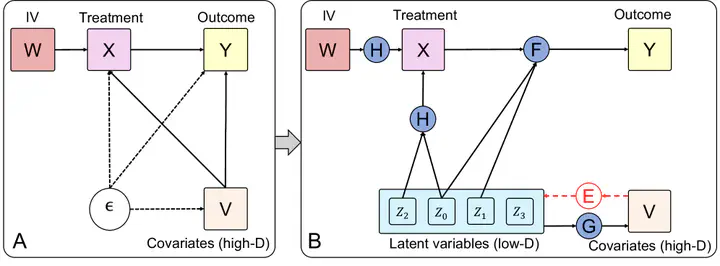
Instrumental-variable (IV) regression enables causal estimation under endogeneity, but modern IV problems often involve nonlinear structural effects and high-dimensional covariates. Existing methods typically operate in observed or generic learned feature spaces, and they often yield point estimates without uncertainty quantification. We introduce BGM-IV, a Bayesian generative modeling approach that performs nonlinear IV regression through posterior inference in a causally structured latent space. BGM-IV separates covariate variation by the role in the treatment and outcome mechanism, and accounts for endogeneity through an IV-integrated pseudo-likelihood that averages over instrument-induced treatment variation. The resulting model provides both structural-function estimates and predictive intervals for outcomes under intervention. Across various benchmark datasets, BGM-IV outperforms existing nonlinear IV methods overall, with significant gains in high-dimensional settings, while achieving near-nominal predictive coverage. These results highlight structured latent generative modeling as a flexible approach to uncertainty-aware IV inference with rich covariates.

Guyue Luo
BIS Master student (2025–2026)
Guyue Luo is an M.S. candidate in Biostatistics (Data Science Pathway) at Yale University, advised by Prof. Qiao Liu. His research centers on causal inference and Causal AI/ML. He is also interested in marketplace applications of causal methods and small-sample learning. Outside of research, he enjoys hiking and is training for the Grand Teton Crest Trail.

Qiao Liu
Assistant Professor of Biostatistics
My research interests include generative AI, high-dimensional data analysis, and computational biology.