Leveraging genomic foundation models to identify genotype-brain-clinical pathways in Alzheimer's disease
Abstract
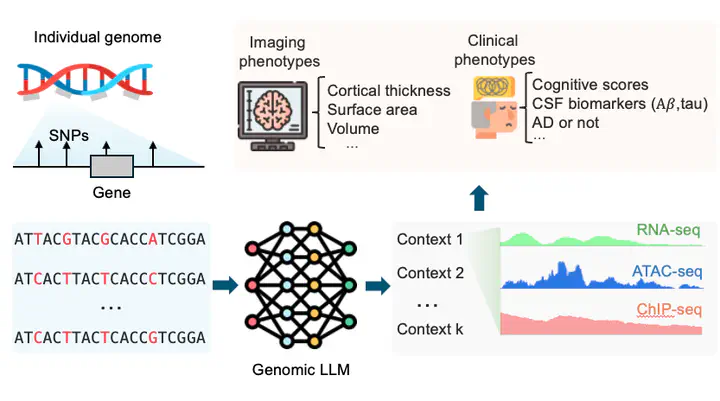
Genome-wide association studies (GWAS) have identified numerous genetic variants associated with Alzheimer’s disease (AD) phenotypes. However, how these variants contribute to the etiology of AD remains largely elusive. Recent advances in genomic large language models (LLMs) have revolutionized regulatory genomic prediction tasks, offering new opportunities to interpret the genetic variation observed in personal genome. In this study, we propose epiBrainLLM, a novel computational framework that leverages genomic LLM to enhance our understanding of the causal pathways from genotypes to brain measures to AD-related clinical phenotypes. Our framework will first convert the personal DNA sequence into a diverse set of genomic and epigenomic features using a pretrained genomic LLM and then use these features to further predict phenotypes. Across various experimental settings, our results demonstrate that incorporating pretrained genomic LLMs significantly improves association analysis compared to using genotype information alone. We conclude that our proposed framework provides a novel perspective for understanding the regulatory mechanisms underlying the AD disease etiology, potentially offering insights into complex disease mechanisms beyond AD.
Qiao Liu
Assistant Professor of Biostatistics
My research interests include generative AI, high-dimensional data analysis, and computational biology.
Haochen Wang
Postdoctoral Associate
Haochen earned his Bachelor of Electronic Engineering degree at Xidian University, where he focused on signal processing and computational techniques. He then pursued his Ph.D. in Control Science and Engineering at Tsinghua University under the guidance of Dr. Xiaowo Wang. His doctoral research concentrated on developing deep generative models for designing genetic elements, with a focus on synthetic biology applications. He also has previous research experience in DNA sequence generation with artificial intelligence during his time at the Shenzhen Institute of Advanced Technology, and computational analysis of single-cell perturbation data at Cartabio Technology. Haochen joined Yale University as a Postdoctoral Associate, and he is currently working on generative models on computational biology.